Real Estate
Chunabhatti’s 48-Acre Land Parcel Moves Towards Development After HC Order
The Bombay High Court has cleared the revival of Swadeshi Mills, potentially bringing its 48-acre Chunabhatti property back into Mumbai’s development pipeline.
The case also covers the settlement of claims involving 2,834 former mill workers, while any future development remains subject to statutory approvals.
min read
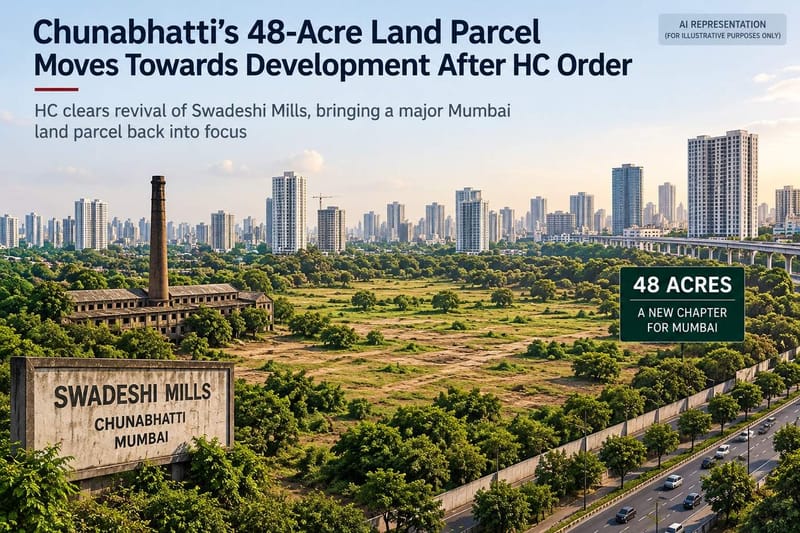
HC order revives Swadeshi Mills proposal, putting a long-stalled Mumbai land parcel back in focus
A large piece of Mumbai’s former industrial landscape could be heading towards a new phase. The Bombay High Court has allowed the revival of Swadeshi Mills Company Ltd., potentially bringing its 48-acre Chunabhatti property back into the city’s development pipeline.
The division bench of Justices A.S. Gadkari and Kamal Khata set aside an earlier order that had rejected the proposed revival. The decision allows the revival arrangement involving Grand View Estates and Forbes & Co. to proceed.
The significance for Mumbai’s property market is the scale of the land involved. A 48-acre contiguous parcel is substantial in a city where large development sites are increasingly difficult to assemble. However, the court order does not by itself authorise construction. Any future development will remain subject to the necessary planning and statutory approvals.
A Long Journey From Mills to Development
Swadeshi Mills dates back to 1890 and was part of Mumbai’s historic textile industry. The company entered winding-up proceedings in 2005, leaving its assets involved in a prolonged legal process.
The revival proposal seeks to change that position. Grand View Estates, associated with the Shapoorji Pallonji Group, and Forbes & Co. together hold a majority stake in the company and had put forward the plan to revive it.
The proposal had previously been rejected by a single judge in February 2026. The division bench has now reversed that decision, allowing the revival arrangement to move ahead.
The Worker Settlement Factor
The property is only one part of the matter before the court. The revival proposal also addresses the claims of former mill workers.
Court proceedings refer to 2,834 former workers covered by the proposed settlement. Their outstanding claims have remained unresolved for years, making the revival proposal relevant not only from a property perspective but also from the standpoint of worker dues.
The court’s decision therefore brings together two long-pending issues: the future of the company’s assets and the settlement of workers’ claims.
Development Opportunity, Not Immediate Construction
The High Court’s decision removes a significant legal obstacle to the company’s revival, but the next stage will involve the practical and regulatory aspects of development.
Planning permissions, statutory clearances and other applicable requirements will determine how and when the Chunabhatti property can ultimately be developed.
The case nevertheless highlights an important shift in Mumbai’s real-estate landscape. Former industrial properties are increasingly becoming potential sources of future development land, particularly where large parcels have remained locked up for years.
Editorial Insight | Signature Media News
The significance goes beyond one land parcel. The Chunabhatti case shows how resolving long-pending legal and stakeholder issues can bring large, strategically located assets back into Mumbai’s real-estate pipeline. The next challenge will be converting that potential into a viable, approved development plan.
Source: Bombay High Court judgment dated September 2, 2026; supplemented by credible media reports.
A large piece of Mumbai’s former industrial landscape could be heading towards a new phase. The Bombay High Court has allowed the revival of Swadeshi Mills Company Ltd., potentially bringing its 48-acre Chunabhatti property back into the city’s development pipeline.
The division bench of Justices A.S. Gadkari and Kamal Khata set aside an earlier order that had rejected the proposed revival. The decision allows the revival arrangement involving Grand View Estates and Forbes & Co. to proceed.
The significance for Mumbai’s property market is the scale of the land involved. A 48-acre contiguous parcel is substantial in a city where large development sites are increasingly difficult to assemble. However, the court order does not by itself authorise construction. Any future development will remain subject to the necessary planning and statutory approvals.
A Long Journey From Mills to Development
Swadeshi Mills dates back to 1890 and was part of Mumbai’s historic textile industry. The company entered winding-up proceedings in 2005, leaving its assets involved in a prolonged legal process.
The revival proposal seeks to change that position. Grand View Estates, associated with the Shapoorji Pallonji Group, and Forbes & Co. together hold a majority stake in the company and had put forward the plan to revive it.
The proposal had previously been rejected by a single judge in February 2026. The division bench has now reversed that decision, allowing the revival arrangement to move ahead.
The Worker Settlement Factor
The property is only one part of the matter before the court. The revival proposal also addresses the claims of former mill workers.
Court proceedings refer to 2,834 former workers covered by the proposed settlement. Their outstanding claims have remained unresolved for years, making the revival proposal relevant not only from a property perspective but also from the standpoint of worker dues.
The court’s decision therefore brings together two long-pending issues: the future of the company’s assets and the settlement of workers’ claims.
Development Opportunity, Not Immediate Construction
The High Court’s decision removes a significant legal obstacle to the company’s revival, but the next stage will involve the practical and regulatory aspects of development.
Planning permissions, statutory clearances and other applicable requirements will determine how and when the Chunabhatti property can ultimately be developed.
The case nevertheless highlights an important shift in Mumbai’s real-estate landscape. Former industrial properties are increasingly becoming potential sources of future development land, particularly where large parcels have remained locked up for years.
Editorial Insight | Signature Media News
The significance goes beyond one land parcel. The Chunabhatti case shows how resolving long-pending legal and stakeholder issues can bring large, strategically located assets back into Mumbai’s real-estate pipeline. The next challenge will be converting that potential into a viable, approved development plan.
Source: Bombay High Court judgment dated September 2, 2026; supplemented by credible media reports.
0
Views
Comments (0)
No comments yet. Be the first to share your thoughts!