Policy
India Makes IST Mandatory as Common Time Standard
The new rules are more than a change in how time is recorded. As banking, digital payments, telecom and critical infrastructure increasingly depend on precise timestamps, a common national time reference can improve coordination, reliability and security across these systems.
min read
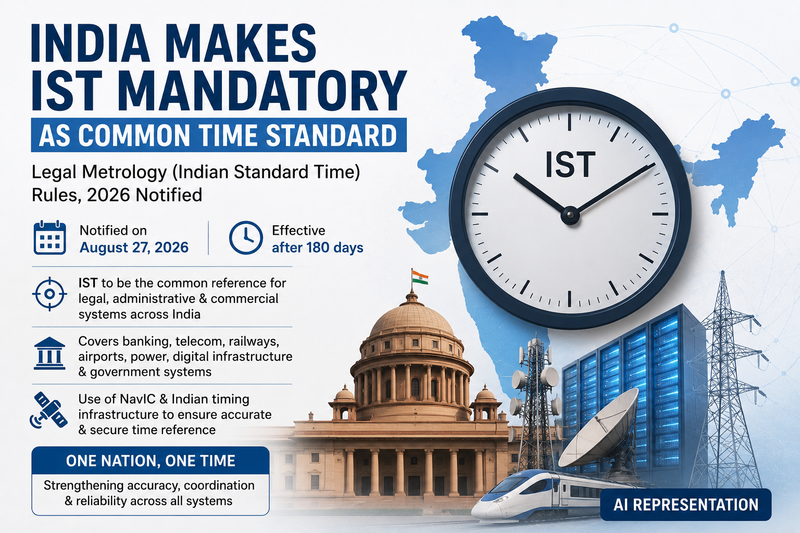
New Delhi: The Centre has notified the Legal Metrology (Indian Standard Time) Rules, 2026, making Indian Standard Time (IST) the common time reference for legal, administrative, commercial and other official purposes across India.
The rules were notified on August 27, 2026, and will come into effect 180 days after publication in the Official Gazette. This gives government departments, businesses and other organisations time to update their systems.
Impact on Digital and Business Systems
The new framework is particularly important for systems that depend on accurate time records. These include banking and digital payments, telecommunications, railways, airports, power networks, computer systems and government records.
Using one common time reference is expected to improve the accuracy of transactions, records and coordination between different systems.
Focus on India's Own Timing Infrastructure
The government is also developing infrastructure to distribute accurate IST through Indian institutions and Legal Metrology laboratories.
The rules allow the use of NavIC (Navigation with Indian Constellation) and other approved Indian timing sources. The move is also aimed at reducing dependence on foreign satellite-based timing sources.
One Nation, One Time
As part of the “One Nation, One Time” initiative, the government has already demonstrated technology for distributing IST across sectors including banking, telecom, power, transportation and digital governance.
Editorial Insight | Signature Media News
The new rules are more than a change in how time is recorded. As banking, digital payments, telecom and critical infrastructure increasingly depend on precise timestamps, a common national time reference can improve coordination, reliability and security across these systems.
Sources: Official statements, regulatory filings, government documents, company disclosures and credible media reports.
The rules were notified on August 27, 2026, and will come into effect 180 days after publication in the Official Gazette. This gives government departments, businesses and other organisations time to update their systems.
Impact on Digital and Business Systems
The new framework is particularly important for systems that depend on accurate time records. These include banking and digital payments, telecommunications, railways, airports, power networks, computer systems and government records.
Using one common time reference is expected to improve the accuracy of transactions, records and coordination between different systems.
Focus on India's Own Timing Infrastructure
The government is also developing infrastructure to distribute accurate IST through Indian institutions and Legal Metrology laboratories.
The rules allow the use of NavIC (Navigation with Indian Constellation) and other approved Indian timing sources. The move is also aimed at reducing dependence on foreign satellite-based timing sources.
One Nation, One Time
As part of the “One Nation, One Time” initiative, the government has already demonstrated technology for distributing IST across sectors including banking, telecom, power, transportation and digital governance.
Editorial Insight | Signature Media News
The new rules are more than a change in how time is recorded. As banking, digital payments, telecom and critical infrastructure increasingly depend on precise timestamps, a common national time reference can improve coordination, reliability and security across these systems.
Sources: Official statements, regulatory filings, government documents, company disclosures and credible media reports.
0
Views
Comments (0)
No comments yet. Be the first to share your thoughts!