Policy
India Plans Battery Storage for New Renewable Projects
India is considering making battery storage mandatory for new government-backed solar and onshore wind projects from July 2027. The proposal aims to improve grid stability and address the challenge of storing surplus renewable electricity.
The plan could boost investment in battery storage, renewable energy and grid infrastructure, marking a shift towards not only generating clean power but also storing and supplying it when demand requires.
min read
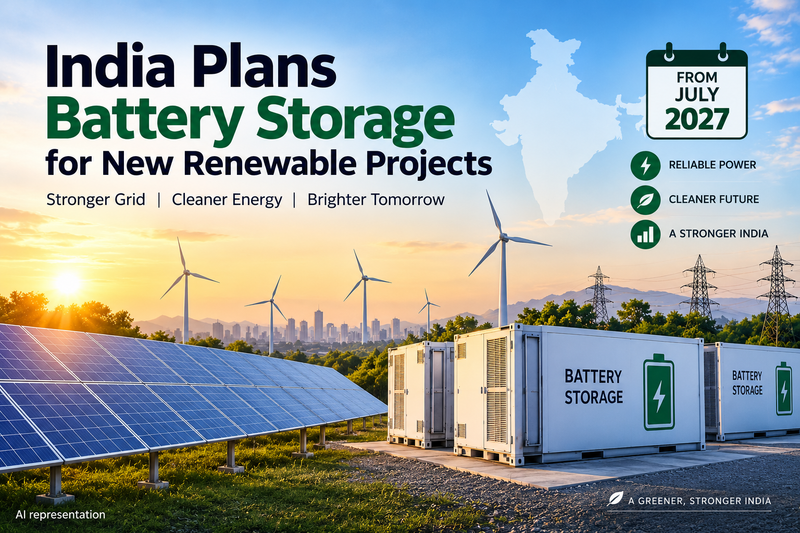
New Delhi: India is considering a new requirement that could make battery energy storage a mandatory part of new government-backed solar and onshore wind projects from July 2027. The proposed measure is aimed at improving grid stability as the country continues to expand its renewable-energy capacity.
Under the draft proposal, renewable-energy projects commissioned from July 1, 2027 could be required to provide battery storage equivalent to at least 10% of their generation capacity, with a minimum two-hour storage duration. The proposed requirement could become more stringent in later years.
The framework also proposes the use of grid-forming inverters, which can help renewable-energy projects support grid stability by assisting with voltage and frequency management.
The proposal comes as India faces a growing challenge in managing electricity generated from solar and wind projects. Solar generation is highest during daylight hours, while electricity demand can remain strong later in the day when solar output falls. Battery storage can help bridge this gap by storing surplus electricity and supplying it when required.
The growing renewable-energy base is also increasing the need for stronger transmission and storage infrastructure. When renewable generation is higher than what the grid can absorb or transmit, some electricity may have to be curtailed. Energy storage could help make better use of this available power.
Editorial Insight | Signature Media News
The proposed requirement signals a shift in India's clean-energy strategy—from simply adding renewable generation capacity to ensuring that renewable electricity can be stored and supplied when needed.
If implemented, the measure could create new opportunities for battery-storage companies, renewable-energy developers, grid-technology providers and infrastructure investors. It could also make energy storage an increasingly important component of India's future power infrastructure.
Sources: Central Electricity Authority, Ministry of Power and credible media reports.
Under the draft proposal, renewable-energy projects commissioned from July 1, 2027 could be required to provide battery storage equivalent to at least 10% of their generation capacity, with a minimum two-hour storage duration. The proposed requirement could become more stringent in later years.
The framework also proposes the use of grid-forming inverters, which can help renewable-energy projects support grid stability by assisting with voltage and frequency management.
The proposal comes as India faces a growing challenge in managing electricity generated from solar and wind projects. Solar generation is highest during daylight hours, while electricity demand can remain strong later in the day when solar output falls. Battery storage can help bridge this gap by storing surplus electricity and supplying it when required.
The growing renewable-energy base is also increasing the need for stronger transmission and storage infrastructure. When renewable generation is higher than what the grid can absorb or transmit, some electricity may have to be curtailed. Energy storage could help make better use of this available power.
Editorial Insight | Signature Media News
The proposed requirement signals a shift in India's clean-energy strategy—from simply adding renewable generation capacity to ensuring that renewable electricity can be stored and supplied when needed.
If implemented, the measure could create new opportunities for battery-storage companies, renewable-energy developers, grid-technology providers and infrastructure investors. It could also make energy storage an increasingly important component of India's future power infrastructure.
Sources: Central Electricity Authority, Ministry of Power and credible media reports.
0
Views
Comments (0)
No comments yet. Be the first to share your thoughts!