Infrastructure
Mumbai 3.0 Gets ₹4,000 Crore Push as New Town Plan Moves Ahead
MMRDA has allocated ₹4,000 crore for the Karnala-Sai-Chirner New Town, or Mumbai 3.0, in its 2026–27 budget.
The proposed city will cover 323.44 sq km across 124 villages in Raigad and is expected to become a new centre for housing, business and infrastructure.
min read
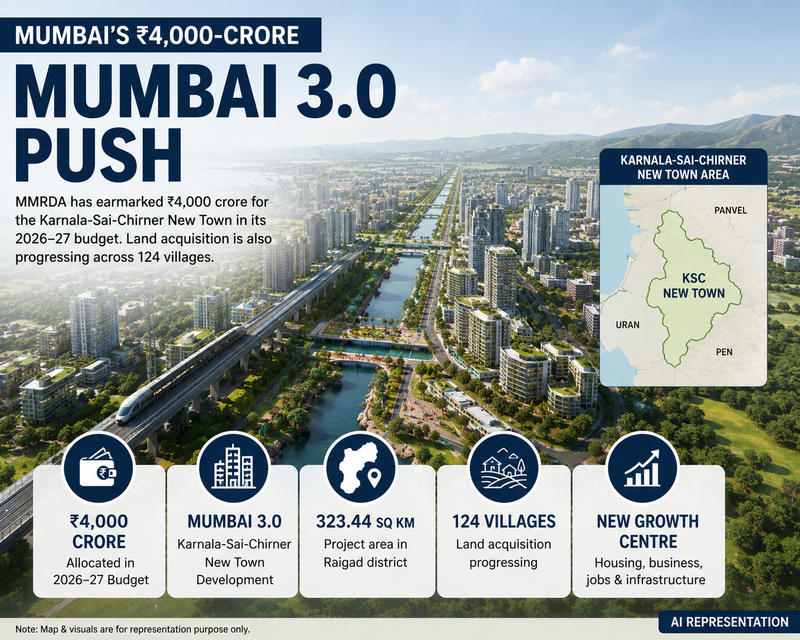
Mumbai: The Mumbai Metropolitan Region Development Authority (MMRDA) has set aside ₹4,000 crore in its 2026–27 budget for the development of the Karnala-Sai-Chirner (KSC) New Town, also known as Mumbai 3.0. The project is planned as a new urban and economic centre in Raigad district.
The proposed new town will cover around 323.44 sq km across 124 villages in the Uran, Panvel and Pen talukas. MMRDA has been appointed as the New Town Development Authority for the area.
Land Acquisition Moves Ahead
MMRDA has also started the process of acquiring land for the project. Landowners in the 124 villages have been offered different options, including monetary compensation, development rights and land pooling.
Under the land-pooling option, eligible landowners can receive 22.5% of developed land in return for their land, subject to the applicable rules.
Focus on New Growth Centre
Mumbai 3.0 is being planned as more than a residential development. The wider plan is aimed at creating new housing, business activity, employment opportunities and supporting infrastructure while helping spread growth beyond the existing Mumbai and Navi Mumbai areas.
The location also benefits from its proximity to major connectivity projects, including the Atal Setu and the Navi Mumbai International Airport.
Infrastructure Investment
The ₹4,000-crore allocation forms part of MMRDA's broader infrastructure-focused 2026–27 budget. The authority has earmarked a large share of its overall spending for transport and urban infrastructure projects across the Mumbai Metropolitan Region.
Editorial Insight | Signature Media News
Mumbai 3.0 could become an important new growth area for the Mumbai Metropolitan Region. The combination of large-scale infrastructure investment, land development and improved connectivity could create opportunities for housing, businesses and employment. The success of the project, however, will depend on planned development, transparent land acquisition and timely infrastructure delivery.
Sources: Official statements, regulatory filings, government documents, company disclosures and credible media reports.
The proposed new town will cover around 323.44 sq km across 124 villages in the Uran, Panvel and Pen talukas. MMRDA has been appointed as the New Town Development Authority for the area.
Land Acquisition Moves Ahead
MMRDA has also started the process of acquiring land for the project. Landowners in the 124 villages have been offered different options, including monetary compensation, development rights and land pooling.
Under the land-pooling option, eligible landowners can receive 22.5% of developed land in return for their land, subject to the applicable rules.
Focus on New Growth Centre
Mumbai 3.0 is being planned as more than a residential development. The wider plan is aimed at creating new housing, business activity, employment opportunities and supporting infrastructure while helping spread growth beyond the existing Mumbai and Navi Mumbai areas.
The location also benefits from its proximity to major connectivity projects, including the Atal Setu and the Navi Mumbai International Airport.
Infrastructure Investment
The ₹4,000-crore allocation forms part of MMRDA's broader infrastructure-focused 2026–27 budget. The authority has earmarked a large share of its overall spending for transport and urban infrastructure projects across the Mumbai Metropolitan Region.
Editorial Insight | Signature Media News
Mumbai 3.0 could become an important new growth area for the Mumbai Metropolitan Region. The combination of large-scale infrastructure investment, land development and improved connectivity could create opportunities for housing, businesses and employment. The success of the project, however, will depend on planned development, transparent land acquisition and timely infrastructure delivery.
Sources: Official statements, regulatory filings, government documents, company disclosures and credible media reports.
0
Views
Comments (0)
No comments yet. Be the first to share your thoughts!